This guide breaks down what custom website design actually means, when it earns its investment, what the process looks like, and how to decide whether it makes sense for your business. I wrote it to give you a straight answer.
What Is Bespoke Website Design?
Bespoke website design means building a site from scratch, specifically for one business. Every layout, page type, content structure, and interaction is created to serve that company’s audience and goals. No pre-bought theme dictates what your site can or cannot do.
This doesn’t mean avoiding all existing technology. Many bespoke sites run on WordPress or modern frameworks like React. The difference is that the design, content model, and functionality are crafted for your actual business rather than reused from a generic starting point.
Template customization, by contrast, takes an existing theme and adjusts colors, fonts, images, and text. The underlying structure, navigation, and page types remain inherited from whatever the original developer built for a broad audience. Bespoke sites provide full control over layout and features because every decision starts with strategy, not a pre-made structure.
Custom web development builds websites around specific business goals. That means the finished site reflects research into your customers, your market position, your content needs, and your commercial objectives, not just what a theme happened to offer.
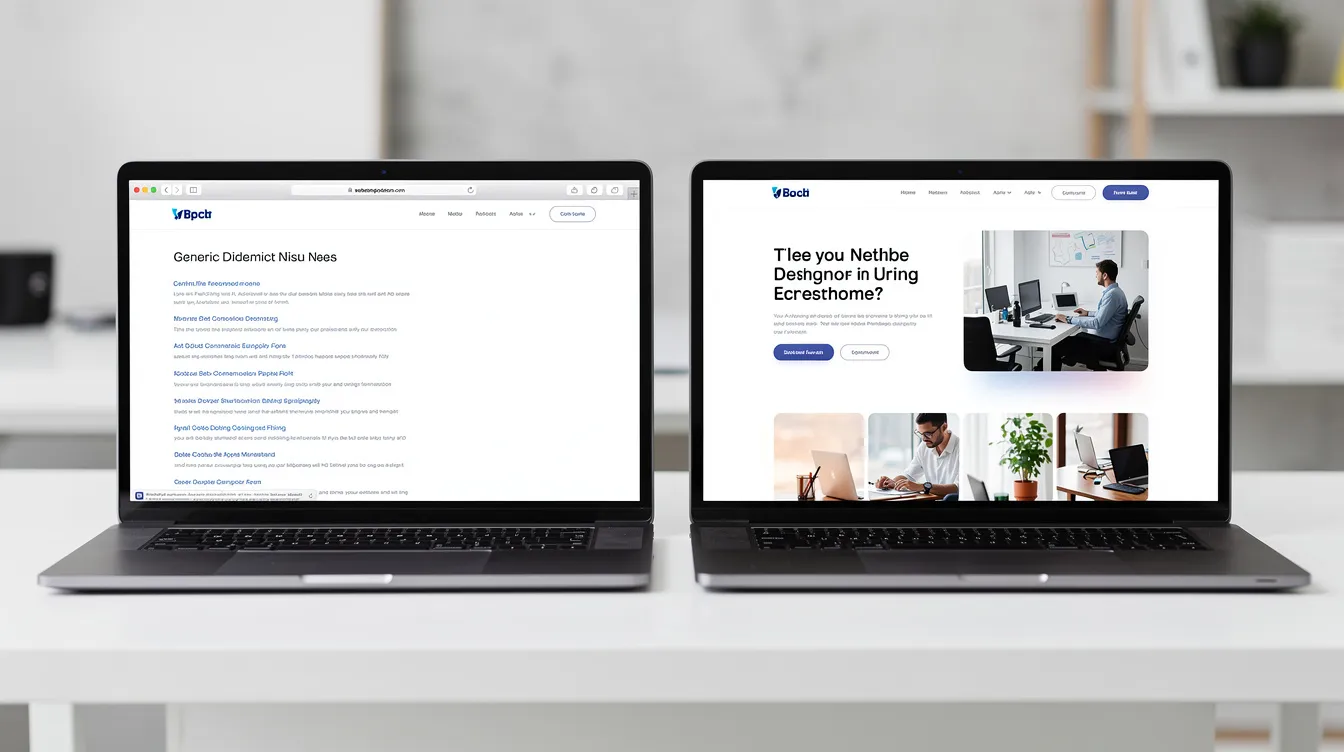
Custom Website Design Versus Templates
The comparison comes down to structure, flexibility, and long-term cost.
| Factor | Templates | Custom Build |
|---|---|---|
| Layout | Pre-defined, limited changes | Built to your specifications |
| Functionality | Plugin-dependent | Purpose-built features |
| Scalability | Constrained by theme architecture | Designed for growth |
| Brand identity | Shared with other businesses | Unique to your company |
| Performance | Often bloated with unused code | Lean, optimized code |
A custom site can adapt to specific business needs without limitations. When your company needs a product configurator, a user dashboard, or a complex search and filtering system, templates force workarounds. Those workarounds usually mean stacking plugins, which bloat code and slow the site down.
Template sites can lock users into specific platforms and pricing. If you outgrow a website builder template, migrating away can mean starting over. Template-based sites can require expensive rebuilds as businesses grow, which erodes the savings you thought you were getting.
That said, templates remain a sensible choice when:
-
Your business is new and still validating its proposition
-
The site is purely informational with no revenue-critical role
-
Budget is tight and speed to market matters most
-
You need a simple page or two, with no custom functionality
Templates aren’t bad. They’re just limited. And for many growing businesses, those limits start costing money within the next few years.
When Custom Work Earns Its Investment
Custom development earns its cost when off-the-shelf solutions can’t deliver what your business needs.
Functions that typically require custom work include:
-
Booking system integration tied to availability or staff calendars
-
Membership portals with gated content or user dashboards
-
Custom quoting or pricing calculators
-
Integration with CRM, ERP, or inventory systems
-
Multilingual content with region-specific functionality
A custom-built site can support functionality like e-commerce, complex search filtering, or dynamic pricing, capabilities that would require painful workarounds in a theme.
Custom sites can support specific functionality like a booking system, letting visitors take action without leaving your site. I do not build booking engines: my websites link to the booking tool you already use, for example in my plan for websites for vacation rentals. This kind of specific functionality reduces friction and keeps customers engaged.
But uniqueness alone isn’t enough to justify the investment. If a distinctive design doesn’t improve clarity, trust, usability, or conversions, it’s decoration. Bespoke design can lead to higher conversion rates through tailored calls to action, but only when those design decisions connect to measurable business objectives.
The question isn’t “do I want something unique?” It’s “will this design difference move my business forward?”
Custom Design for Small Business Growth
Small business owners face tight budgets and limited internal technical skills. That makes the decision harder, but it also makes the outcome more impactful when done right.
Visual design shapes how people judge a website’s credibility, and first impressions decide whether a visitor trusts you enough to inquire or buy. Bespoke design enables tailored user experiences based on specific audience behaviors, which means your site works harder for every visitor. Many small business sites share the same popular themes, so a custom one has room to do better.
Here’s a simple customer-value calculation to test whether custom investment makes sense:
-
Estimate your current monthly revenue from website leads or sales
-
Estimate a conservative conversion improvement from better UX
-
Calculate the additional monthly revenue
-
Multiply by 36 months (a reasonable site lifespan)
-
Subtract the extra cost of bespoke over template
If that number is positive, custom design is commercially sensible. If it is negative, a template is the better use of your money. My pricing page shows what a custom build costs so you can run the numbers.
Bespoke design can lead to a more professional online appearance for businesses, which directly influences how customers perceive your services and pricing power.
Discovery Before Web Design
Discovery is where bespoke design earns its “bespoke” label. Skip this phase and your custom site risks being a template in disguise.
Identify target audiences. Who visits your site? What are their motivations, pain points, and decision-making patterns? Customer interviews and analytics on existing visitors provide the foundation. Custom websites can be tailored for specific audience needs when you understand those needs first.
Define visitor goals. What do you want visitors to do? Submit an inquiry? Book a consultation? Browse a portfolio? Each goal shapes the page structure, navigation, and calls to action.
Review existing content. What content exists, what’s outdated, and what needs creation? This determines page types, such as blogs, case studies, FAQs, and testimonials, and the content model the site will use.
Document technical requirements. This covers integration needs, accessibility standards, performance targets, SEO requirements, security, hosting preferences, and domain ownership, while also planning for future updates, maintenance, and later feature or content changes.
Discovery and planning define the project’s scope before design begins. The artifacts produced, including sitemaps, wireframes, content inventories, and technical specifications, become the blueprint for everything that follows.

The Bespoke Web Design Process
The web design process for a custom build follows a structured sequence, and each phase feeds the next.
Discovery and planning. As covered above, this stage produces audience research, competitor analysis, content strategy, technical requirements, and a defined scope. It’s where you align the project with business priorities.
Wireframe development. Low-fidelity layouts map out structure, content placement, and navigation before any visual direction is applied. You review wireframes to confirm that user journeys make sense. Changes here are fast and cheap, changes after development are neither.
Visual design approval. High-fidelity mockups bring the wireframes to life with typography, color, spacing, imagery, and component design. A style guide or design system ensures consistency. This is where creativity meets brand identity, and where you confirm the visual direction before a single line of code is written.
Development and testing. Front-end and back-end development begins, integrating components and functionality. Custom web development typically takes several weeks depending on complexity. Quality assurance tests every feature before the site goes live: cross-browser compatibility, responsive behavior, form submissions, performance benchmarks, and accessibility checks.
Turning Custom Design Into a Usable Website
A stunning website means nothing if people can’t use it. Three practices protect usability during the build:
Use realistic content during wireframing. Filler text hides problems. Real headlines, actual product descriptions, and genuine images reveal whether a layout works or breaks when filled with content that varies in length.
Test layouts across screen sizes. Bespoke web design can support mobile-friendly experiences across devices, but only if responsive testing happens throughout development, not as an afterthought. Touch targets, font sizes, and navigation all behave differently on a phone versus a desktop.
Preserve familiar navigation patterns. Custom design allows innovation, but visitors still expect a logo that links home, a clear menu, and predictable page structure. Deviating too far from convention confuses users and hurts conversions.
Building a Flexible Custom Website
A custom site built today needs to serve your business for years. Flexibility is essential.
Content management requirements. Define who will update text, add blog posts, or publish new services. The content management system should let non-technical team members handle routine updates without calling developers. WordPress remains a popular choice, but the platform should match your editing needs, not the other way around.
Reusable content structures. A good design system includes components, such as cards, testimonials, accordions, and call-to-action blocks, that can be combined to build new pages without additional development. This approach lets your site grow without requiring a redesign every time you add a service.
Custom websites can easily add new features as businesses grow because the architecture is designed for extension, not locked into a rigid theme.
Essential integrations. CRM connections, payment gateways, marketing automation, analytics, and any third-party services your business relies on. Plan these during discovery so the site architecture supports them cleanly.
Ownership of code, content, and accounts. Custom-built sites can give you complete ownership of design and code. Confirm who owns the design files, source code, hosting accounts, and domain. At handover, you should have access to everything. Custom websites can come with complete ownership of design and code when the agreement says so, a significant advantage over template platforms where the design stays on the platform.
Custom development allows tailored security measures for specific risks, meaning your site’s defenses match the threats relevant to your industry rather than relying on generic protections. Bespoke websites offer greater flexibility and scalability than templates, making them a stronger foundation for long-term growth.
Performance, Accessibility and SEO
These aren’t optional extras. They’re core to any serious custom build.
Performance targets. Define benchmarks in the project scope: a fast page load, specific Core Web Vitals scores, and asset size limits. Custom websites can load faster than template-based sites because the codebase includes only what’s needed, with no unused theme features dragging things down. Bespoke websites allow businesses to reduce reliance on third-party plugins, which can slow pages down.
Accessibility testing. Test keyboard navigation, screen reader support, focus states, color contrast, and semantic HTML structure. These aren’t just ethical obligations, they expand your audience.
Search visibility. Bespoke websites can enhance search engine optimization through structural control. Clean heading hierarchies, proper metadata, schema markup, XML sitemaps, and optimized URLs all contribute to how well search engines understand and rank your content.
Preserving URLs during redesigns. If you’re replacing an existing site, map every important old URL to its new equivalent and set up 301 redirects. Failing to do this can destroy years of search equity overnight.
Brand Differentiation Through Custom Design
Visitors form aesthetic judgments quickly. Before they read a word, they may already have decided whether your site feels professional or amateur.
Custom websites reflect your brand, not a shared template. When your site looks like dozens of other businesses using the same theme, you’re invisible. Custom design helps avoid blending in with competitors’ sites, which is especially critical in competitive markets where trust and credibility drive purchasing decisions.
Unique designs improve brand recognition and user experience. Original typography, custom illustrations, and distinctive interaction patterns create a visual language that belongs to your company alone.
Visual choices should align with audience expectations. A luxury brand needs minimalism and high-quality imagery. A technology company needs clean, modern layouts. A local services business needs warmth and approachability. Study what competitors do well and where they fall short, then use those insights as strategic references for your own visual direction.
Bespoke Website Design Costs
The upfront cost of bespoke design is generally higher than template options. Here is how the levels typically compare:
| Approach | Typical Cost |
|---|---|
| Premium WordPress themes | Lowest |
| Freelancer-customized templates | Middle |
| Agency custom websites | Highest |
Custom web development costs more upfront than template-based sites, but the comparison isn’t complete without looking at recurring expenses and long-term value.
Project fees vs recurring costs. Beyond the initial build, factor in hosting, ongoing maintenance, security updates, content changes, feature additions, and future updates or changes. Template sites may seem cheaper but often accumulate costs through premium plugin subscriptions, platform fees, and, most significantly, painful rebuilds when outgrown.
What drives development costs up:
-
Number of unique page templates or content types
-
Custom integration with external systems
-
Advanced functionality (configurators, portals, search)
-
Multimedia content and animation
-
Accessibility depth
-
Revision cycles and stakeholder feedback rounds
Investment vs value. Compare the extra cost against expected business outcomes. If a bespoke site costs more than a template but brings in extra revenue each year through improved conversion and brand positioning, the payback period can be short, and the site continues generating returns beyond that. See pricing for what I charge.
Choosing a Custom Web Design Partner
Not every agency or developer calling their work “bespoke” actually delivers it. Here’s how to evaluate a potential partner:
Request relevant portfolio examples. Look beyond aesthetics. Check whether portfolio sites demonstrate relevant experience with projects similar in complexity or industry to yours. Ask for case studies with measurable results, such as conversion improvements, speed benchmarks, and lead increases.
Evaluate the delivery process. Does the agency include discovery? Wireframing? Design iterations? What does their communication structure look like? A partner without a clear process will likely deliver a site that looks custom but functions like a dressed-up theme.
Confirm post-launch support. Ask about bug fixes, security updates, performance monitoring, and feature additions after launch. Understand what’s included and what costs extra.
Check technical ownership. Who owns the code, design files, hosting account, and domain at the end of the project? Are there dependencies on proprietary tools or technology that could create lock-in? A trustworthy agency hands over everything.
Launch, Handover and Ongoing Custom Work
The project doesn’t end when the site goes live.
Test critical visitor journeys. Before launch, walk through every important path: contact form submissions, purchase flows, sign-ups, and downloads. Test on multiple devices and browsers. Broken steps at launch mean lost money from day one.
Document editing responsibilities. Clarify who handles content updates, who manages technical changes, and what training the team needs. A good handover includes documentation and a walkthrough of the content management system.
Confirm backup procedures. Establish how often backups run, where they’re stored, and how quickly the site can be restored if something goes wrong.
Create an ongoing maintenance plan. This covers CMS updates, dependency patches, security scanning, performance monitoring, and periodic content reviews. A maintenance plan protects your investment and keeps the site performing well over time.
Is Bespoke Website Design Right for Your Business?
Custom development makes sense when:
-
Your website is a primary revenue or lead generation channel
-
You need specific functionality that templates can’t deliver
-
Brand differentiation matters in your market
-
You plan to scale features, content, or services over the next few years
-
Performance, accessibility, and SEO are mission-critical
Templates may suffice when:
-
You’re validating a new business idea and need speed
-
The site is purely informational with no conversion goals
-
Budget is genuinely constrained and ROI is uncertain
-
Requirements are straightforward with no custom integration
The answer isn’t always “go custom.” It’s “match your website investment to what your business actually needs.”
Start by defining what your own website must accomplish. If those goals demand tailored user experiences, conversion optimization, or innovation in how you serve customers on the internet, bespoke is the path that moves your business forward. If a simple presence is enough for now, launch with a template and revisit as your company grows. If you want to talk it through, send me a message on the contact page.